"Music produces a kind of pleasure which human nature can not do without." ~Confucius
Showing posts with label Rhythm. Show all posts

Tuesday, January 29, 2013

"Head and Shoulders" a la Haydn


Probably the most meaningful way to understand music is to MOVE to it. I was just telling a piano student yesterday, as she was struggling through a Minuet, that it's really silly that we sit and struggle over music when in fact, Minuets were meant to be "felt" as you danced to them, rather than labored through in painstaking repetition. When it comes down to it, making meaningful movements to music enables the mind to feel and understand rhythm and melody better than anything else!

This activity today is a short example of getting kids moving to music - in this case, a very well-known classical melody: the 2nd movement of F.J. Haydn's "Surprise Symphony." It's my simple version  from a more detailed presentation of this activity presented by John Feierabend  (John Feierabend is one of my favorite Music Ed. guru's out there. He and his wife have a passion for music, movement and getting the littlest among us involved in music making. Pick up any of his recordings, books, etc. for a broad and meaningful beefing up of your little one's musical experiences).

So, again, for this activity, we used the 2nd Movement from the "Surprise Symphony"
(For those out there wondering, "what is a movement anyway?" A movement is a part of a symphony. There are usually 4 movements (sometimes more or less), which make up the classical model of a symphony. Kind of like a book with 4 chapters. Each is a little different, they may have new characters or settings, but they are all connected to the main story).

The materials needed are only: a recording of this movement and some little kiddos!

What makes this a "surprise" symphony is that Haydn sticks loud chords in an otherwise quiet piece of music (when he was composing this, he was reacting to the annoying tendency of some audience members to fall asleep during the typically slow 2nd movement... he was a funny guy, that Haydn).
The rhythm and structure of the opening line lends itself to a simple sound-description using "Head and Shoulders Knees and Toes"

First - Teach kids the actions and the words:

Head and Shoulders, Knees and Toes, (tapping for each syllable)
Head and Shoulders, Knees and Toes,
Now a quiet splat.    splat.  (stay down on "toes" then say quietly, "splat")


Head and Shoulders, Knees and Toes, (same: tapping each syllable)
Head and Shoulders, Knees and Toes, 
Now a great big splat.   SPLAT!!!  (stay down on "toes", then jump with a loud, "SPLAT!")

When I told the boys we were going to play a game with "Head and Shoulders" and a SPLAT!, they were very excited... mostly for the "Splat" mystery. :-)  

Practice the motions, then tell them we're going to do it with the "Surprise" song. Tell them to listen to the piece (the first 35-40 seconds) and tell you when they hear the loud "Splat." Usually their faces will light up in a big smile when it happens. :-) 

Next, try this activity with them... keeping it quiet until the big splat! 

See the video below for how we did it (and you will see baby M wandering around too, with his hands on his head to be like the brothers... it's a family affair here!) 

Give it a try - it's especially fun in these winter months to have a few movement activities up your sleeve when you're spending more time indoors. :-) 

Tuesday, November 6, 2012

Counting and Clapping in Rhythm

Counting is recently my kiddos' favorite thing to do. So, what a great time to do some simple practice with counting in rhythm!

Did you ever do those hand clapping games on the playground when you were little? Like, "Miss Mary Mack, Mack, Mack, all dressed in black, black, black, etc...." Or the other ones where you slapped hands backwards and forwards while chanting and counting to astronomically high numbers....? (those were the ones the really smart girls did....)  These types of games are so valuable on a  number of levels:

  • They are fun games that make practicing counting (in whatever sequence it involves) a more challenging and motivating activity.  
  • They are spoken/sung in rhyme and rhythm, enhancing and strengthening the child's innate rhythm. 
  • They involve hand movements which increase muscle-control and agility.
  • They are a meaningful and enjoyable activity between friends, bringing smiles and satisfaction.   
So, I'm not going to try anything complicated with my 3 and 4 1/2 yr. old boys yet; we'll start basic!

First we got thinking musically by singing and clapping one of our favorite songs, "A Sailor Went to Sea, Sea, Sea"

Here are the words and for the melody, go Here!

A Sailor Went to Sea
A Sailor went to sea, sea, sea
To see what he could see, see, see, 
But all that he could see, see, see
Was the bottom of the deep blue sea, sea, sea. 

Hand motions: 
You can be as creative as you'd like,
We always clap each other's hands on each "sea, sea, sea" (or "see, see, see").
We also sit up tall on "sailor"
We put our hand to our forehead to 'peer out' on "to see what he could..."
Put our hands up to the side in an "Oh well" manner on "but all that he could..."
Put our hands to the floor on "was the bottom of the..."

We get incrementally faster and faster - it's fun. :-)


Then we moved to a clapping and counting chant.
First have child choose a number.

Then, in rhythm, chant and clap:

"Let's see how high we can count,
watch my count to _____"

Then, with either you or another child, clap hands together in rhythm (as much as possible anyway, depending on your child's age/ability), counting up to that number.

J chose numbers that didn't take us quite as long, like 8 and 12.
K wanted more exciting ones in his little 4 yr. old mind, like "32" and "21 and 11 and 16"
"So, you want 48?"
"Yeah!!!"
You can also have them alternate clapping each others' hands with the front and back of their hands. Keeps it a little more exciting... :-)


This is uber simple and you can adapt it to practice any type of number recitation, but it was great practice and we had fun with it; hope you can too!


Thursday, October 11, 2012

Halloween Syllable Clapping


There are many ways to teach children the natural rhythm all around them. One of these ways is to engage them in thinking about the rhythm in words.
When you break down words by syllables, it's easy to create a rhythm activity geared to the interests of your child.

Our guys are into all things spooky and Halloween-y currently, so my music-nerd mind thought "Bingo!!" - it's another opportunity to practice rhythm while having a Halloween activity (love those two-fer's).

So, this one needs a little bit of prep.
Your materials are:  construction paper, print-outs of Halloween (or fall-themed) pictures, coloring or painting supplies, scissors and glue.
Oh yeah, and one or two (or more!) adorable children.

To find images, do a search for whatever Halloween or Autumn pics you'd like by looking for coloring pages. Those are usually large enough and are usually free to print. Look for ones with nice, solid lines.

These are the ones we looked for:
3 syllables: skeleton
2 syllables: pumpkin
1 syllable: ghost (actually we called the ghost Boo! because both boys love to say that word whenever possible right now)  and bat.

If you don't want Halloween images, you can search for seasonal things like candy apple, pumpkin, scarecrow, candy corn, apple, leaf, etc...

1. Gather your pictures on your computer, adjust sizes, print and cut them out.

   2. Have child color or paint pictures. I printed mine on cardstock thinking they'd want to paint them, but they got a hold of these pictures before I knew it and started using markers. Whatever!
 3. Go over the name for each item and clap by syllables as you name them to get the child into hearing the rhythm of each word.
4. Tell child to arrange 3 in a row and clap the names in rhythm. It's helpful to point along as they go. Alternate this with clapping along also. Some may need one more than another.
5. Have child rearrange and clap as many times as their interest holds. Mom/Dad can help them to incorporate words with different patterns so there's a good mix.
These pics are blurry because K was jumping around back and forth doing his clapping, which I thought was hilarious. You can see my finger trying to keep him on track as he flies back and forth.

 6. Before they're spent, have the child arrange all the pics on the page, glue them on and then make a story about the pictures, and encourage them to clap along for the special Halloween words as they go. You can use your rhyming agility to make the stories rhyme if possible to continue in the musical component if you'd like.

 For example, J's story was something like.... "Along came Boo who saw skeleton too, and said "howdy Do!" Look, let's go scare pumpkin one and pumpkin two!" Not the most fluid, but it was something like that...

Proudly display their fine work and then go get a Halloween treat. :-)


Thursday, September 13, 2012

Five Little Apples Chant and Finger-Play

Fall is *almost* here, so we're starting to get excited about all things apple (although most of the excitement is geared towards those things involving food).

This chant is about getting apples off a tree and involves a counting pattern from 5 down.

Why are chants or fingerplays worth my time, you may ask?

Well, my two top reasons are: they are rhythmic and rhyming, so they develop innate rhythm, which is uber important to instill at a young age since it is very hard to rectify a deficiency in natural rhythm as a child grows up.

Second, it strengthens their imagination and story-following ability. The rhyme and the actions help them to learn a story or routine; and they can mentally follow along with what's happening that much better.

So, this is one of my favorite chants/finger-plays, and it is easy-peasy to learn.


5 Little Apples - A Counting Chant

5 little apples in the apple tree,
The juiciest apples that you ever did see.
I shook that tree as hard as I could,
and down fell an apple and 'mmmm' was it good!

4 little apples in the apple tree....
3 little apples in the apple tree.....
etc...

The motions we used are as follows:

First, we had to make sure our hand had five fingers.
 Then we began the chant (by the time mommy started taking pics, little J was about done!)

"5 little apples...
...in the apple tree
 
the juiciest apples that you ever did...

 ...see!
 I shook that tree as hard as I could...  (this was the boys' favorite part... surprised?)

and down came the apple...
And mmmm, was it good!
 On the last apple that came down, we changed the words to "it was sooooooooooooooooooooo good!"- where they had to try and see who could hold "soooooo" for the longest. It was silly. :-)

Here's a quick video clip at the end of the fun, so it's not the best, but you get the idea!

Don't forget the Boynton (click:) Philadelphia Chickens CD Giveaway!

Tuesday, May 15, 2012

Syllable Clapping with Flowers

Spring is just wonderful... Just when I think I'm going to cave in and go cuckoo from winter, spring has come to the rescue. :-)

So, celebrate the season by rhythm practice!

Today, we used flowers. This one is great because we'll:

  • Learn or review flower names.
  • Incorporate rhythm by chanting the syllables of each flower name.
  • Create our own colorful "gardens"

You'll need either pictures of flowers, or you can use silk flowers, if you have enough varieties laying around (we don't...).  I printed off some various flowers with different syllable-length-names by doing an internet search for coloring pages of each flower.
If you want to print them out in color, look for free clipart images of each flower.

Here are the ones we used....

One syllable: Rose, Fern (<-- I know it's not a flower, but I needed another one-syllable one that the kiddos were sort of familiar with...)
Two Syllables: Tulip, Lily, Daisy
Three Syllables: Daffodil, Buttercup, Sunflower
(If you want a four-syllable one, you could use Dandelion, or some other one... but we just used the ones above.)

You can paste each into a Word Doc, adjust the size, and type the flower name.
Print off, cut out and you're good to go.


Other materials: construction paper (background... we used blue for the sky), some extra stems or leaves, brown paper for soil on the ground, crayons/markers/paint and glue.

Gather kiddos and have them color flowers (if needed). I helped them choose a correct or at least appropriate color for each one as we rehearsed their names...


Next, get your "garden bed" ready:

Little J really wanted a leaf in the middle of his page.... :-)

Next, choose two or three flowers to arrange on the page (don't glue yet).
As child chooses each flower, clap and chant that flower's name and have them imitate it back.

Once all three have been chosen, clap them rhythmically in a sing-songy way.
Chant it loud and proud along with them.
 Sometimes it helps to point along once in a while....
And, not every activity appeals to all children...
He did jump in once in a while, if no one was paying attention. Otherwise, he got shy. Poor little J... :-)


After you've created a few different "gardens," finish off by having them glue on their favorite ones, then either chant that one as the grand finale, or if you've exhausted their focus, say what a wonderful job they did and release them to go play. :-)


Have fun!

Friday, May 11, 2012

Buckets of Fun


Today was a lovely day... to go outside and make some noise.
We have some buckets laying around, which many of you do as well.... So, we continued in our drum theme this week and did some simple tasks with the buckets.

All you need for this is a kid, a bucket, and a few sticks of some sort. We do have drum sticks around the house, but they have been moved somewhere by some toddler who will remain nameless... so we used markers today.

You'll need a bucket-drum for each kiddo....

We gave one to the baby, but he had other plans...

My goals today were to do simple imitation patterns and descriptive sounds.

So, after a bit of 'free drumming,'  mom started by playing a simple rhythm      (ta, ti-ti. Or, Long, quick-quick, etc. etc....)
and they had to imitate. K (4) did fine, J (2) banged back roughly the same thing every time.  :-)

We went around and each tried to "imitate" the sounds made by the one who's turn it was.
J often did sound effects with his demonstrations. Very amusing.

Whereas your student may desire to just bang aimlessly, to develop rhythm and musicianship, do your best to get them thinking about imitation, patterns, loud/soft, fast/slow, etc...

****Remember, your role is demonstration! Show them how it is done correctly and help them with ideas. They want to succeed in these little things and they need you to help them to understand and to inspire them.


Next, we described sounds. For example,
"How would it sound if we were tiptoeing?"  or "What would it sound like if we were marching?" 
Speed: 
"What if we were running away from a big monster?"  or  "What if we were walking very, very slow?" 
"What if we were walking first, then started to race?" 


Then... what different ways can you make noise on the drum?

Here's K dropping his "sticks" rather than striking. 


So simple, so much potential.... so fun! Enjoy!

Friday, April 13, 2012

Clapping Game = Sneaky Rhythm Practice

Well, today I felt like I hadn't done anything very musically stimulating with the boys all week... so of course I decide to do something when they're crankiest right before nap time. Brilliant, I know.
They were getting testy with each other and needed to go to bed a diversion by their dear mother.

So, I thought we could do a clapping game (what I told them) which would include some organized rhythm training (what I told myself).

Very simple. Here's what we used:
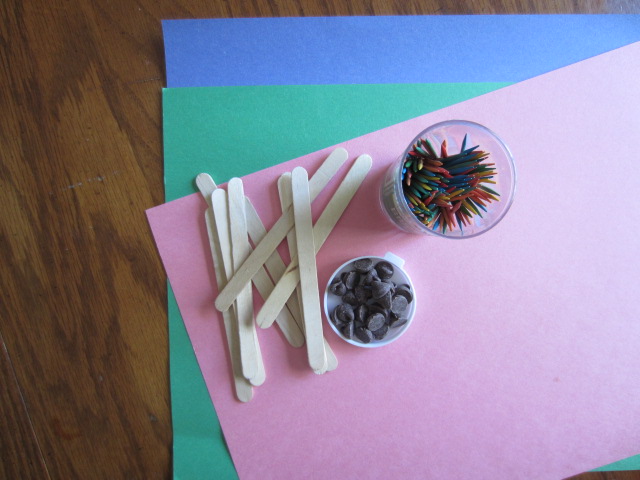
popsicle sticks, tooth picks, some treats (if needed.. and oh yes, they were needed today), and some paper for a confined "work" surface.

The goals of this activity were to: 

  • Teach concept of fast and slow beats.
  • Teach concept of creating and describing a pattern (In our case, the description was rhythmic).
  • Get rhythm in their body!!


The popsicle sticks represent
a quarter note (one beat)  Vocalized as "Ta"
Two toothpicks represented a set of eighth notes (1/2 beat each). Vocalized as "ti-ti"

Each person gets 4 Ta's and 8 ti-ti's (or less depending on age).


The parent/teacher will demonstrate first - with LOTS of demonstrating as you go.... or else all the kids' clapping will sound the same instead of having the difference between the slow and fast notes.

Tell kiddos to arrange the ta's and ti-ti's on their page to make a clapping pattern.

I made one first to demonstrate:
Counted:

Ta, Ta, ti-ti

(slow, slow, quick-quick)

They did great echoing this back to me clapping and chanting it.

When they did it correctly, they got a chocolate chip.


Pointing as you go is a good idea to help them follow along and not get lost... who's really used to reading a bunch of sticks on a page, anyway?


Now it was their turn.

I helped K demonstrate for all of us, then we each tried to copy him, all of us receiving a chocolate chip for our wonderful effort.

Keep going around as long as you'd like and as long as their interest holds.
This is K telling us he could do this "hard" one he made up because he's really, really strong. :-)

I felt a bit like I was feeding the dolphins at Sea World when they performed a nice trick by giving the boys a chocolate chip for each wonderful demonstration, but it was helpful at this time of day, and made it more fun anyway. So, whatever works, sometimes! :-)

Enjoy!